 by
by 
When people start looking for a new HVAC system, they usually end up comparing equipment first. Brands, efficiency ratings, warranties, rebates… Let’s be honest, it all feels like the most important part of the decision (and the toughest one). On paper, that makes sense. But HVAC systems don’t really behave like standalone products. How they perform depends just as much on how they’re installed and set up as on the unit itself.
A well-installed mid-range system will often outperform a premium unit installed poorly. Not because the equipment is inferior, but because HVAC performance is shaped in the field — through sizing decisions, airflow balancing, duct conditions, and calibration that never appear on a spec sheet. In practice, installation is not a step in the process. It is the process.
Where homeowners usually get misled
Most HVAC decisions start with comparisons. One contractor emphasizes premium brands, and at the same time another focuses on price. A third leans heavily on urgency or limited-time offers. At some point, the technical conversation gets replaced by noise.
What tends to matter more? Well, the questions that are often overlooked are how the system is being sized or whether ductwork is being evaluated or reused without inspection and who is accountable after the job is done.
The best HVAC proposal isn’t always the cheapest one. Before you sign a contract, make sure you’re comparing what’s actually included — not just the final price. Use the comparison checklist below and see what is the best choice possible:
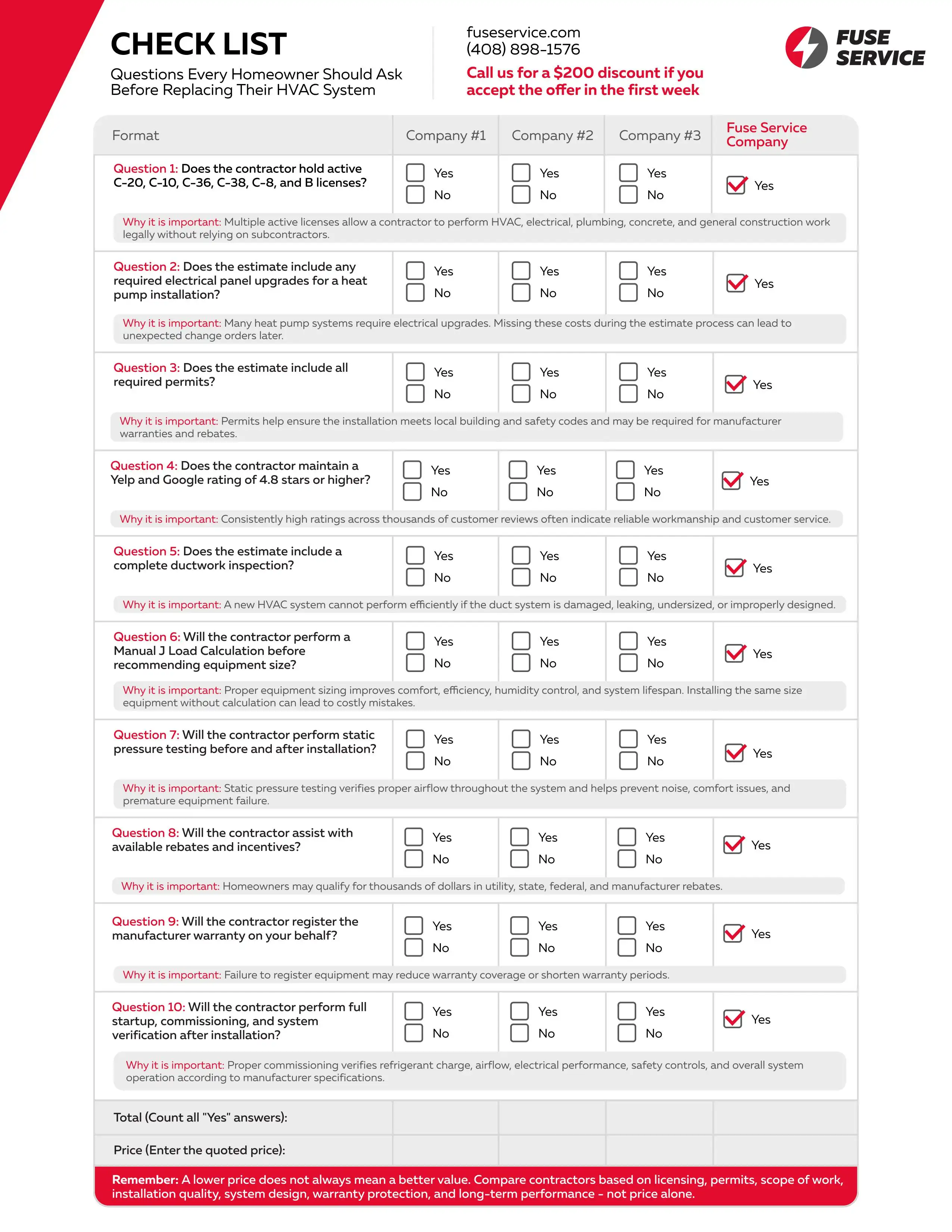
Those details rarely appear in marketing materials, but they often determine long-term performance.
Accountability is the real product
Licensing and insurance are not selling points — they are the baseline. They define whether a contractor is operating within a regulated framework and whether a homeowner is protected if something goes wrong. Most established companies treat this as standard procedure, not something to negotiate.
Permits fall into the same category. While often viewed as bureaucratic friction, they create traceability. Years later, they can become the difference between a smooth property sale and unexpected complications.
Price rarely tells the full story
In HVAC work, pricing is often less about cost and more about structure. A lower bid can look attractive until it becomes clear what has been excluded — duct adjustments, electrical updates, commissioning steps, or permit handling. These are not optional extras; they are often essential parts of a proper installation.
When those elements are removed from the initial scope, they rarely disappear from the project. They simply resurface later.
The overlooked variable
HVAC systems are often framed as products. In reality, they are assembled environments. The equipment matters, but it does not operate independently. It depends on the system around it — and the people who configure that system.
Which is why experienced homeowners tend to shift their attention. Not away from equipment entirely, but toward the conditions that determine how that equipment will actually perform. Because in the end, comfort is not something you buy once. It’s something that is built.